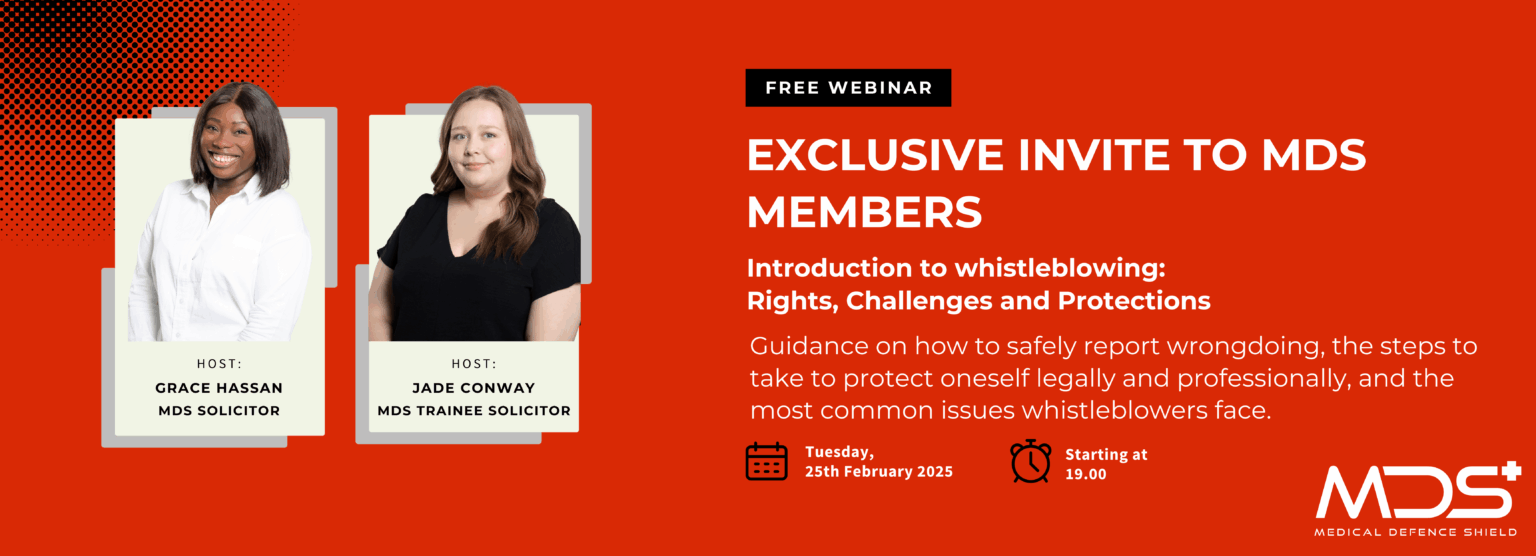
whistleblowing nhs webinar banner

Whistleblowing: Rights, Challenges and Protections

Crucially, the webinar included guidance on how to safely report wrongdoing, the steps to take to protect oneself legally and professionally, and the most common issues whistleblowers faced.

Whistleblowing was an enabler of transparency and accountability within organisations. This webinar provided valuable insights into the legal landscape, challenges, and practical advice.
If you are a MDS member and would like to view a recording, get in touch at [email protected].

Not a member? Sign up today to access our exclusive webinars.

Date: 25th February 2025

Speakers: Grace Hassan and Jade Conway

About the speakers:

Grace Hassan is a commercially focused, determined, and proactive solicitor from Bedfordshire. She graduated in 2016 with a 2:1 LLB Law degree, before going on to complete the Legal Practice Course. She qualified as a solicitor in 2021. Born in Nigeria, Grace moved to the UK at the age of 12.

What particularly excites her about working at Medical Defence Shield is its dedication to safeguarding members’ professional interests while providing the highest level of legal protection and guidance. She is especially passionate about helping people in the workplace and finds great satisfaction in offering reassurance and achieving the best possible outcomes for members.

Jade Conway is a Trainee Solicitor at MDS, where she supports healthcare professionals with a variety of medico-legal, regulatory and employment matters. Jade joined MDS in 2022 shortly after graduating from the University of East Anglia with her Bachelor of Laws. She began her solicitor training in November 2023 and has recently obtained her Master of Laws in Legal Practice from BPP University. Jade is passionate about contributing to the protection and support of those working within the healthcare sector.

Webinar summary

What is Whistleblowing?

From a legal perspective, whistleblowing is when someone raises a concern about wrongdoing, risk, or malpractice by an employer. However, to be classified as whistleblowing under the English legal framework, there must be a “protected disclosure”.

There are four key requirements for a protected disclosure to qualify as such:

  • It must convey facts, not opinions.
  • It must cover one of the following categories: Criminal offenses, breach of legal obligation, miscarriage of justice, danger to health and safety, environmental damage, or deliberate concealment of these.
  • The whistleblower must have a reasonable belief that the information is in the public interest, not just a private/personal concern.
  • The whistleblower must believe the malpractice has happened or is likely to take place.

If these requirements are not satisfied, a submission will not be protected as whistleblowing, and this is where many cases fail.


Legal Protections and Remedies

The law protects employees from dismissal if they make a protected disclosure. Such a dismissal is automatically unfair, you are protected from day one of your employment. Employers are also prohibited from subjecting workers to a “detriment” (victimisation). 

In case of unfair dismissal or victimisation following a protected disclosure, redress can include legal action. There is no financial cap on compensation in whistleblowing claims, however, remedies differ: employees can be reinstated, while workers might be entitled to personal injury damages.


Whistleblowing in Healthcare

Medical professionals have a duty to raise concerns about patient safety..Regulators including the GMC note that while doctors may fear career impact or complaints, their duty to put patients first overrides personal or professional loyalties.

However, clinicians may face barriers, real or perceived, to whistleblowing. These may include:

Fear of reprisal, blame culture, racism, lack of clinical representation at the executive level, and heavy pressure on staff. 

Legal framework

Current laws are largely reactive and rigid. While the government published a code of practice in 2015, it has no statutory force. 

Several reforms are proposed. The “Office of the Whistleblower Bill” seeks to centralise the current system (which involves 88 different regulatory bodies) and set mandatory standards. The charity Protect is also campaigning to extend protections to volunteers and medical students and to increase the legal claim time limit from three to six months.


Practical Advice for Whistleblowers

  • Get legal advice early
  • Put everything in writing
  • Read your organisation’s policy on whistleblowing
  • Follow the process: 


If you are a MDS member and would like to view a recording, get in touch at [email protected].

Previous Webinars

tom and victoria feature (1)
Read More
workplace conflict webinar feature
Read More
clinicians guide to social media webinar feature
Read More